Samsung Galaxy Note9 Power of Technology Gala: a launch staged for about 1,000 guests
The Galaxy Note9 was launched to consumers and technology enthusiasts as a single-session gala, with a product experience circuit placed before the show.
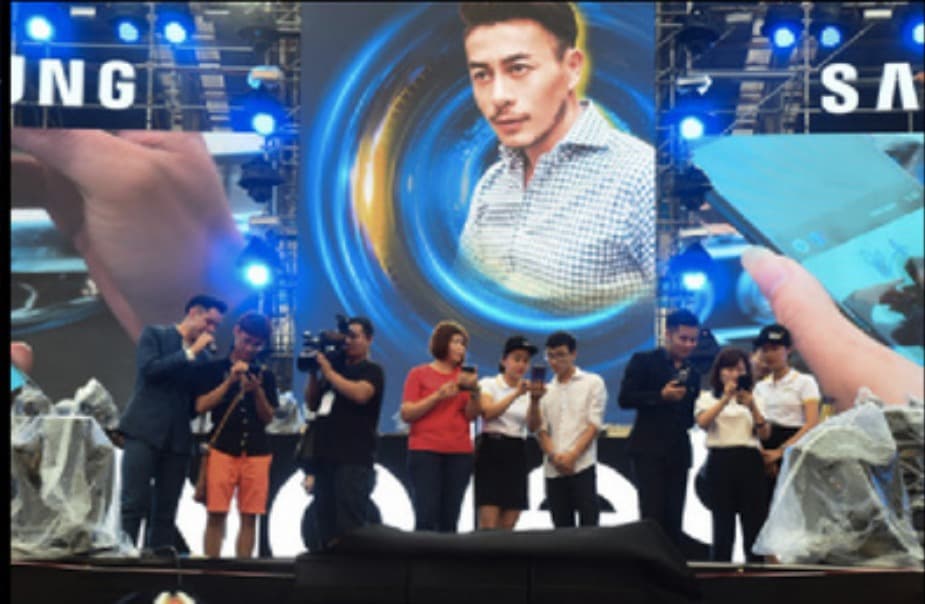
- Guests
- ~1000 people
- Duration
- 1 session
- Audience
- Consumers and technology enthusiasts.
- Objective
- Launch the Samsung Galaxy Note9 with the message "The power of technology gala".
- Services provided
- Organizing the large-scale launch event, staging and product experience.
The brief was to launch the Samsung Galaxy Note9 under the message the power of technology gala. The audience was consumers and technology enthusiasts, around 1,000 people. It ran as a single session.
The recorded scope covers organising the large-scale launch event, staging, and product experience. Those three items describe a night with two distinct halves, and the sequencing between them turned out to be the design decision that mattered.
The main stage was built around a tower-scale numeral nine at its centre. At this size the set is the argument. A message about power delivered to a thousand people in one room is carried by the physical scale of what they walk into, long before anything is said from the stage.
Before the show, guests were queued through a product experience circuit, so the device was in hand before it was presented. That order is deliberate. A demonstration seen after a phone has already been held lands against a real impression rather than creating the first one.
There is a second, less glamorous function to that circuit. A thousand guests arriving for one session is a queue-management problem, and an experience route absorbs arrival time by giving people something to do while the room fills. The same structure serves the product and the door.
Consumers and enthusiasts in the same room set a particular bar. Enthusiasts arrive knowing the specification and are unimpressed by it being read aloud, while general consumers need the reason to care. A circuit plus a gala splits those two jobs rather than asking one stage to do both.
Questions we ask afterwards
- What was the single problem this event was hired to solve?
- The objective line sets the product and the register together: launch the Samsung Galaxy Note9 under the message the power of technology gala. The audience is recorded as consumers and technology enthusiasts in the same session of around 1,000 people, and that mix is the actual difficulty in the brief. Enthusiasts arrive already knowing the specification and are unmoved by hearing it read aloud, while general consumers need the reason to care at all.
- What could a room do here that a video, a mailer or a showroom could not?
- A message about power is carried by physical scale, and scale is the one thing a screen cannot transmit, since a tower-scale numeral nine reduced to video is simply a graphic. In the room it is something around 1,000 people walk into before anything is said from the stage. The second thing the room provides is the device in hand, which no mailer or film can deliver at the moment the argument is being made.
- What changed between the first concept and the version that was actually built?
- No concept drafts are held. The recorded scope covers organising the large-scale launch event, staging and product experience, and the built version placed the experience circuit before the show rather than after it. That order is the decision worth naming, because a demonstration seen after a phone has already been held lands against a real impression instead of creating the first one, and on this format sequencing is where a concept most often changes.
- Which element took the longest to get right, and what made it difficult?
- There is no time record for the build, so this is a judgement. At around 1,000 guests the slowest element to settle is normally the relationship between the circuit and the seated show, meaning how many stations there are, how long each takes, and whether the whole room can clear the circuit before the programme starts. The set is a fabrication problem with a deadline; the throughput calculation is an arithmetic problem that keeps changing as the guest list does.
- What was the hardest constraint on site — venue, load-in window, power, weather, permits or something else?
- The record gives Vietnam and one session, with no venue named and no site notes. The constraint the record does imply is that single session for around 1,000 guests, because a tower-scale set and a full experience circuit have to be built, rehearsed and struck around one show, which puts the whole production inside one venue booking. A set of that height also makes rigging capacity and ceiling clearance the venue question that has to be answered first.
- How were guests moved through the space, and what happened at the tightest point in the flow?
- The route is recorded, in that guests were queued through the product experience circuit before reaching the show. That structure has a second function beyond the product, since around 1,000 people arriving for one session need something to do while the room fills, and an experience route absorbs arrival time instead of leaving a queue at the door. The tight point in any such shape is the transition from circuit to seating, though our records hold no account of what happened on the night.
- What was measured afterwards, and what did the numbers say?
- The recorded figure is around 1,000 people. No coverage count, no circuit throughput and no post-event measure was recorded in our sources. Attendance is the only number this launch left behind, and no claim about its commercial effect is made here.
- If the same brief arrived tomorrow, what would be done differently?
- The circuit would be instrumented, since it is the one part of the night that produces a number naturally, and how many of the guests actually handled the device, and for how long, is a direct measure of whether the format did its job. We would also brief the two audiences separately rather than as one line, because consumers and enthusiasts were asked into the same session, and giving each a stated success condition would make the split in the room a design input instead of a note in the audience column.