Sapporo Premium Beer Brand Activation: a point-of-sale roadshow reaching around 2,000 people
Sapporo Vietnam's premium beer was taken to supermarkets and trade outlets through point-of-sale material and a roadshow built around sampling.
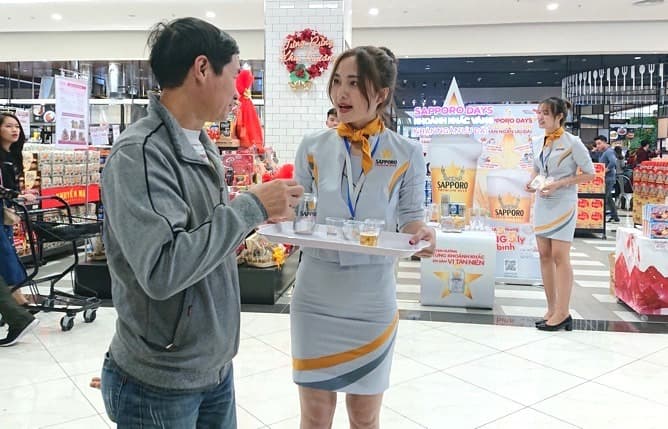
- Reach
- ~2000 people
- Duration
- Multi-store activation campaign
- Audience
- Premium beer consumers.
- Objective
- Brand Activation for Sapporo Premium Beer at points of sale, increasing brand awareness and product experience.
- Services provided
- POSM design, organizing roadshow/activation at points of sale.
The objective was brand activation for Sapporo Premium Beer at points of sale, increasing both brand awareness and product experience. The audience was premium beer consumers. Reach is recorded at around 2,000 people, and the entry is filed as a multi-store activation campaign.
Two things carried it: point-of-sale material design, and a roadshow and sampling programme run across supermarkets and trade outlets. Awareness and experience appear together in the objective, and each of the two deliverables answers one of them.
Sampling does the heavier work for a premium product. A price premium asks a shopper to accept a claim about quality, and no amount of shelf material settles that argument on its own. A glass in the hand does, in the same visit, which is why the two halves were run together rather than in sequence.
The material has a second job once the sampling ends. A display that stays behind is what a shopper meets on the next visit, when there is nobody there to pour anything, and it has to be recognisable enough to reconnect to the taste already experienced.
One detail in the record is worth reading carefully. Reach here is counted in people, around 2,000, whereas other campaigns on the same list are counted in selling locations. Different counting units are not comparable, and treating one campaign's people as another campaign's stores would misread both.
Questions we ask afterwards
- What was the single problem this event was hired to solve?
- The objective names two outcomes at one location: brand activation at points of sale, increasing both brand awareness and product experience. A price premium asks a shopper to accept a claim about quality, and shelf material alone cannot settle that claim. The problem was therefore to get the product tasted in the same visit in which it was noticed.
- What could a room do here that a video, a mailer or a showroom could not?
- Taste is the claim, and no medium transmits it. A film can state that a beer is worth its premium, whereas a glass poured in the outlet settles the question in the same minute, with the alternative on the shelf beside it. That is why the second half of the objective, product experience, cannot be delivered by any channel reaching people away from the point of sale.
- What changed between the first concept and the version that was actually built?
- No concept-stage material is held for this campaign, so no change can be reported. The two recorded deliverables answer one half of the objective each, with point-of-sale material for awareness and the roadshow and sampling programme for product experience. What usually has to be reconciled on a premium brief is exactly that pairing, since material designed to look restrained on shelf and a sampling stand designed to attract attention pull in opposite directions.
- Which element took the longest to get right, and what made it difficult?
- Our records do not time the work, so this is judgement. On a premium activation the element that takes longest is the point-of-sale material, because it has to hold its quality while being produced in enough volume for supermarkets and trade outlets and installed by people who did not design it. Material that only looks right in the first outlet has failed the brief, and reaching a specification that survives repetition is slower than designing a single stand.
- What was the hardest constraint on site — venue, load-in window, power, weather, permits or something else?
- No site record exists, and a multi-store campaign has no single site. The constraint specific to this one is sampling itself, since it depends on each outlet's own permission and rules, on glassware, chilling and serving conditions, and on staffing at every location. Supermarkets and trade outlets do not grant those on the same terms, so the roadshow format has to survive being trimmed store by store.
- How were guests moved through the space, and what happened at the tightest point in the flow?
- No guests were moved through a space here, because the format meets shoppers on a route the outlet has already set. The equivalent decision is where the sampling stand sits relative to the chiller, and the tight point is the handover, since a shopper who has accepted a glass has both hands occupied and cannot pick up the product being sold. Our records hold no observation from any individual outlet.
- What was measured afterwards, and what did the numbers say?
- The recorded figure is around 2,000 people. Nothing else was recorded, with no sampling conversion, no repeat purchase and no outlet-level comparison held in either source. One detail in that number is worth reading carefully, since reach here is counted in people while other campaigns on the same list are counted in selling locations, and the two units are not comparable.
- If the same brief arrived tomorrow, what would be done differently?
- The counting unit would be fixed first, so that a campaign recorded in people and a campaign recorded in selling locations can sit on the same list without being misread. On the work itself we would record two numbers at each outlet, samples poured and units sold during the same session, because on a premium product the ratio between them is the only direct evidence that the taste argument moved anyone. Neither figure can be recovered once the roadshow has left.