FUJIFILM GFX100 Launch: a medium-format camera introduced through a print gallery
The GFX100 was launched in Ho Chi Minh City to retailers, press and professional photographers, in a room built as a product experience space first and a launch theatre second.
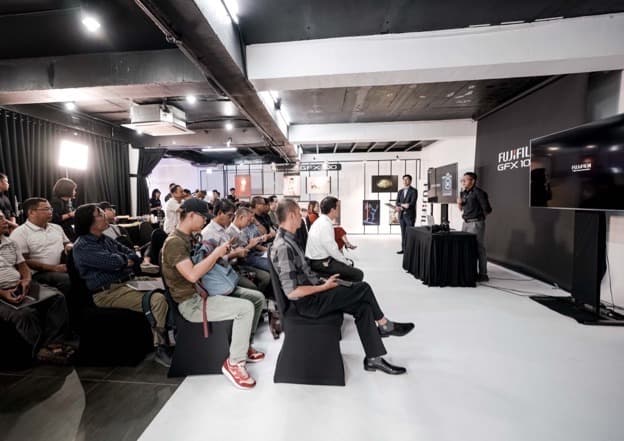
- Guests
- ~100
- Duration
- 1 session
- Location
- Ho Chi Minh City, Vietnam
- Audience
- Retailers, press reporters and professional photographers (over 50 guests).
- Services provided
- Organizing the product launching event, designing the product experience space.
The brief was to launch the FUJIFILM GFX100 medium-format mirrorless line and, in the words of the event list, affirm the highest image quality in professional photography. The audience was recorded as retailers, press reporters and professional photographers, noted as over 50 guests. It ran in Ho Chi Minh City as a single session.
Two services were recorded against it: organising the product launch event, and designing the product experience space. Those are separate jobs. The second one is what shaped the night, because the room itself had to carry the claim the camera was making.
The space was built as a print gallery first and a launch theatre second. A statement about image quality is hard to make from a stage, since a projector flattens exactly the detail being argued about. Print does not, and a professional audience reads prints for a living, so the argument was left to the photographs on the walls.
The guest count on the event list is recorded as roughly 100, while the audience column notes over 50 guests. Both figures come from the same source and both are reproduced here without reconciling them. What is clear either way is the mix in the room.
Three groups with three different reasons for attending is a harder brief than one large uniform audience. Retailers, journalists and working photographers each judge a camera against a different question, and a launch that satisfies only one of them has done a third of the job. Reading the guest list as part of the brief, rather than as a detail of it, is the practical lesson from this one.
Questions we ask afterwards
- What was the single problem this event was hired to solve?
- The objective line sets a claim to be established rather than a product simply to be shown: launch the GFX100 mirrorless line and affirm the highest image quality in professional photography. The problem was that the claim had to be made to an audience qualified to reject it, with retailers, press reporters and professional photographers in the same room. A specification read from a stage does not settle an image-quality argument with people who assess images for a living.
- What could a room do here that a video, a mailer or a showroom could not?
- Image quality is the one product claim a video cannot carry, because the medium destroys the argument: a projector, a phone screen or a compressed file flattens exactly the detail under discussion. A print does not, and a print at scale can be walked up to. That is why the recorded scope lists designing the product experience space as a service separate from running the launch, since the room was the evidence rather than the setting.
- What changed between the first concept and the version that was actually built?
- We hold the delivered scope and not the drafts, so no specific change can be reported. The scope itself lists two services separately, running the launch and designing the product experience space, which is worth noting because a launch brief more often treats the room as production rather than as a design deliverable. Where a concept moves on a night like this it moves in the balance between the two, meaning how much of the evening is spent seated facing a stage against how much is spent walking the prints.
- Which element took the longest to get right, and what made it difficult?
- No build log survives, so this is a judgement about the work rather than a record of it. In a room whose whole argument is image quality, print selection and lighting are the slowest items, because a print lit at the wrong colour temperature or hung against a competing light source loses precisely the detail it was chosen to demonstrate. Every other element in the room can be adequate; the prints cannot, since a professional audience reads them at close range.
- What was the hardest constraint on site — venue, load-in window, power, weather, permits or something else?
- The record gives the location as Ho Chi Minh City and the duration as one session, and holds no site report. The constraint that follows from the format is lighting control, since a gallery hang and a launch stage want opposite light, one flat and even across the walls, the other directional with the room dark. Fitting both into one venue for one session is the practical difficulty, and it is a venue-selection problem before it becomes a rigging problem.
- How were guests moved through the space, and what happened at the tightest point in the flow?
- No flow record for the night is held. The shape the record implies is gallery and then presentation, so that guests read the prints on arrival and then turn to the stage, which loads the argument before the speaking begins. The tight point in that shape is the turn itself, because a room of roughly 100 people distributed along walls has to become a room facing one direction, and prints hung nearest the stage are the ones nobody finishes looking at.
- What was measured afterwards, and what did the numbers say?
- Two guest figures are recorded and they do not agree, since the guest column reads ~100 while the audience column says over 50 guests. Both are reproduced as they stand rather than reconciled. Beyond the headcount, no coverage count, no retailer follow-up and no other measure was recorded, so attendance is the only number this event left behind, and even that one is held twice and differently.
- If the same brief arrived tomorrow, what would be done differently?
- The count would be settled at the door, since a record holding ~100 in one column and over 50 in another cannot support any later analysis. The larger change is to the brief, because three audiences applying three different tests, a retailer asking what sells, a journalist asking what is new and a photographer asking what the file looks like, should carry three separate objectives rather than one line covering all of them. With press in the room a coverage list is also the cheapest measure available, and it was not taken.