FUJIFILM X-T30 Photography Workshop in Hanoi: a camera introduced through a working session
Rather than a launch, the X-T30 was put in front of Hanoi's photography community as an experience-sharing workshop with three guest photographers.
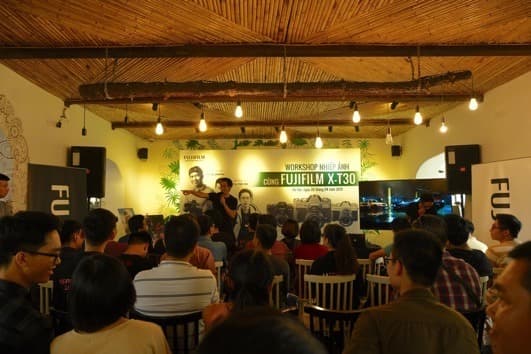
- Guests
- ~50
- Duration
- 1 session
- Location
- Hanoi, Vietnam
- Audience
- The photography-loving community and followers of the guest photographers.
- Services provided
- Organizing the workshop, inviting and managing guest speakers.
The objective on record was to introduce the FUJIFILM X-T30 through an experience-sharing workshop with photographers Hung Lekima, Chu Viet Ha and Eric Kim. The audience was defined as the photography-loving community and the followers of those guest photographers. It ran as one session in Hanoi for around 50 people.
The format is the decision worth noticing. Same brand, same year, and a very different room from the GFX100 launch in Ho Chi Minh City. A workshop asks the audience to do something rather than watch something, which suits a camera aimed at enthusiasts rather than at studio professionals.
The recorded scope was organising the workshop and inviting and managing the guest speakers. Around that sat guest management, hands-on camera benches and the room build. Benches matter in this format, because a session built on shared practice fails if there are not enough cameras in enough hands.
Around 50 guests is small by event standards and correct by workshop standards. A room that size allows questions to be asked out loud and answered individually, which is the mechanism a workshop actually runs on. Doubling the number would have changed the format into something else.
There is a second point buried in the audience line. Defining the audience partly as the followers of the guest photographers means the guest list is a function of who is on the panel. Speaker selection was therefore an audience decision as much as a content one.
Questions we ask afterwards
- What was the single problem this event was hired to solve?
- The objective line specifies both the product and the mechanism: introduce the FUJIFILM X-T30 through an experience-sharing workshop with photographers Hung Lekima, Chu Viet Ha and Eric Kim. The problem was therefore not to announce a camera but to get it used, in front of an audience that judges a camera by handling it. A launch would have addressed the first half of that and none of the second.
- What could a room do here that a video, a mailer or a showroom could not?
- Experience sharing is a two-way format, and the return direction is the part that cannot be filmed. A video carries what a photographer says, but not the question asked from the third row, the answer given to that one person, or the camera passed across a bench so a setting can be shown rather than described. A room of around 50 is small enough for all three to happen, which is the mechanism a workshop runs on.
- What changed between the first concept and the version that was actually built?
- No concept drafts are held for this session, so nothing specific can be reported as changed. The two recorded services, organising the workshop and inviting and managing the guest speakers, indicate where movement usually sits on this format, because the panel is fixed before the content is. Once three photographers with different practices have accepted, the session has to be rebuilt around what each can demonstrate rather than around a running order written in advance.
- Which element took the longest to get right, and what made it difficult?
- Our record names the services and not the hours, so the ranking is judgement. On a three-speaker workshop the slowest item to settle is the division of the session between the guests, since three practitioners covering the same camera will overlap unless each is given a distinct part of it, and that is negotiated across three separate conversations rather than one. The room build and the benches are fixed work by comparison, because once the number of cameras per guest is decided the bench layout follows.
- What was the hardest constraint on site — venue, load-in window, power, weather, permits or something else?
- The record gives Hanoi and one session, with no site notes. The constraint particular to this format is equipment rather than venue, because a hands-on workshop is limited by how many bodies, lenses and charged batteries are on the benches, and a session where guests wait for a camera stops being a workshop. Power and table space follow from that same number, so the equipment count sets the room rather than the other way round.
- How were guests moved through the space, and what happened at the tightest point in the flow?
- No flow record for the session is held. The structure implied by the record is a shared talk followed by bench time, which means the whole room moves at once from seated to handling. That transition is the tight point on this format, since roughly 50 people arriving at the benches simultaneously will queue unless the benches are split and the group is released in parts.
- What was measured afterwards, and what did the numbers say?
- The only figure recorded is ~50 guests. No sign-up rate, no post-session survey and no reach figure from the guest photographers' own audiences was recorded, which is a gap worth naming given that the audience was defined partly as their followers. Attendance is the whole of the measurement, and nothing further is claimed.
- If the same brief arrived tomorrow, what would be done differently?
- The measurement would be built into the format rather than added after it. When the audience is defined as the followers of three named photographers, the registration source is the obvious thing to capture, meaning which guest each attendee came for, and that costs nothing at sign-up but cannot be reconstructed later. We would also record the camera-to-guest ratio at the benches, because on a hands-on session that single ratio explains more about how the room went than the headcount does.