Dat Xanh Group Sports Day: a 15th anniversary run as a one-day staff competition
Dat Xanh Group marked fifteen years by putting 300 of its own staff on the field for a day instead of in front of a stage.
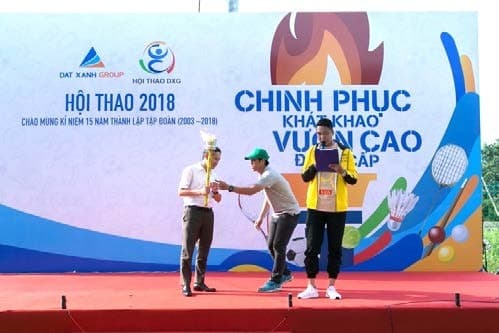
- Guests
- 300
- Duration
- 1 day
- Audience
- Dat Xanh Group staff and employees
- Objective
- Celebrate the group's 15th anniversary (2003–2018), strengthen internal bonding through the Sports Day
- Services provided
- Organizing the 2018 internal Sports Day
Dat Xanh Group reached its fifteenth year in 2018, counting from 2003. The brief recorded on the event list is plain: celebrate the anniversary and strengthen internal bonding through a sports day. The audience was the group's own staff and employees, with no customers and no press on the list.
That framing decided the format. An anniversary aimed at staff does not need a keynote and a screen, it needs something everyone can take part in. The day was built as a competition, with the programme organised around team events rather than a stage schedule.
The build carried an identity of its own. A torch ceremony opened proceedings and a trophy presentation closed them, with a branded mascot and a full site build in between. The scope on record was organising the 2018 internal Sports Day in full.
Three hundred staff competed across a single day. That scale reads differently against this format than against a seated one: three hundred people in motion for a full day is a different logistical problem from three hundred people seated for two hours. Registration, kit, timing and scoring have to hold for the length of a working day rather than the length of a show.
What the day was for sits in the objective column and nowhere else. The event list records no sales figure and no awareness target against it, only the anniversary and internal bonding. For an internal event of this kind that is the honest measure, and it is the one the brief asked for.
Questions we ask afterwards
- What was the single problem this event was hired to solve?
- The brief on the event list carries two clauses and no third: celebrate the group's fifteenth anniversary, counting 2003 to 2018, and strengthen internal bonding through the sports day. Nothing on the record asks for customers, press or sales. The problem was therefore an internal one, which is how to turn a corporate milestone into a day 300 staff take part in rather than sit through.
- What could a room do here that a video, a mailer or a showroom could not?
- Internal bonding is the one objective a broadcast cannot serve, because it is produced by people acting together rather than by people receiving the same message. A film or a mailer reaches the same 300 staff and leaves them where they already were, inside their own departments. A field puts them on mixed teams for a day, and the team is the mechanism the brief actually named.
- What changed between the first concept and the version that was actually built?
- No concept-stage material for this project survives in our records, so we cannot say what moved. What is recorded is the version that was delivered: a torch ceremony to open, a trophy presentation to close, a branded mascot and a full site build. Where a first concept and a final build differ on a day like this, it is usually the number of competition events, because the programme has to fit a single day once heat times and rest gaps are added.
- Which element took the longest to get right, and what made it difficult?
- Our records name the elements delivered but not the hours each one took, so the ranking here is judgement rather than a log. On a one-day competition for 300 staff the schedule is normally the slowest thing to settle, since every event has to be timed, seeded and scored so that no team stands idle and the trophy presentation can begin when it was advertised. The mascot and the site build are visible work with a fixed end point; the schedule is the piece that keeps being rewritten until the day itself.
- What was the hardest constraint on site — venue, load-in window, power, weather, permits or something else?
- The record gives the location only as Vietnam and the duration as one day, and holds no site report, so no constraint can be cited as the hardest one. The structural constraint visible in the record is the single day itself: a full site build has to be standing before the first heat and cleared after the trophy presentation, which puts build and strike either side of the same working day. On sports formats the other recurring constraint is daylight, because a competition schedule that slips cannot be finished in the dark.
- How were guests moved through the space, and what happened at the tightest point in the flow?
- No flow plan and no incident record exists for this event, so nothing about the day itself can be reported here. Structurally the day had two moments where all 300 staff had to be in one place, the torch ceremony that opened it and the trophy presentation that closed it, with the competition spread across the site in between. The tight point in that shape is normally the return, since dispersed teams converging for a closing presentation arrive at different speeds, whereas the opening has a fixed start time everyone has already been given.
- What was measured afterwards, and what did the numbers say?
- The only figure recorded against this event is 300, the number of staff who competed. No survey, no participation rate and no follow-up measure was recorded, and none is claimed here. For an anniversary whose stated purpose was internal bonding, no commercial target was set in the brief either, so there is nothing further to report.
- If the same brief arrived tomorrow, what would be done differently?
- The change we would make is to the record rather than to the day. An internal bonding objective can be tested cheaply with a short question put to the 300 participants afterwards, and because that was not set up in advance the event closed with a headcount and nothing else. We would also capture the participation split by department at registration, since on a mixed-team format that is the figure which shows whether bonding across the group actually occurred.